Disposable Camera at Your Wedding: Why Couples Are Bringing This Trend Back
Disposable cameras at weddings hit differently. There's a rawness and surprise to those photos that no professional shot can replicate. Here's why the trend is back, and how couples are doing it smarter than ever.
The disposable camera wedding trend never fully disappeared. It dipped out of fashion for a decade when everyone got smartphones, and now it's coming back: partly for the aesthetic, partly for the genuine value of photos that nobody previewed or deleted.
If you're considering disposable cameras for your wedding, here's everything you need to know.
Why Disposable Cameras Work at Weddings
The no-preview constraint
The most important thing about a disposable camera is the thing it can't do: show you the photo you just took. This constraint changes how people shoot: less calculating, less self-conscious, more instinctive. The photos that result feel fundamentally different from smartphone photos taken with the option to reshoot and filter.
The element of surprise
When a disposable camera comes back from development, you genuinely don't know what's on it. There might be 24 shots of someone's ceiling. There might be a perfect, completely accidental portrait that becomes the best photo of the wedding. The uncertainty is the point.
Guest participation without pressure
A camera on a table signals permission: "you're allowed to take photos here, it's actually encouraged." Many guests who would feel awkward raising their own phones feel comfortable picking up a camera that's been put there for exactly this purpose.
A parallel album to the professional one
Professional wedding photographers are everywhere. But they can't split themselves into 15 people. Guest-captured photos fill in gaps that no single photographer can cover: the conversation in the corner, the group at the kids' table, the best man's speech face from the front row.
The Practical Realities of Physical Disposable Cameras
The costs add up
Fujifilm disposable cameras run around £12 to £18 each. For a 100-guest wedding with one camera per table of 10, that's already £120 to £180 before development. Development costs add another £10 to £15 per roll, and scanning adds more. A full project: cameras, development, scanning: can run £300 to £500 for a medium-sized wedding.
Quality is limited
Disposable cameras have fixed-focus lenses and low-sensitivity film. In low-light situations (evening receptions, church interiors), many shots will be blurry, dark, or poorly exposed. This is part of the charm, but also means you should expect only 20 to 40% of photos to be keepers.
Development time means delayed delivery
Most development labs take 1 to 3 weeks. Some are backed up longer. The wedding is over, the honeymoon might be done, and you're still waiting to see what your guests captured. The wait has its own appeal, but it also means you can't share the photos at the post-wedding celebration.
Cameras get left behind or stolen
Disposable cameras have legs. Not all of them make it back to you at the end of the night. It's reasonable to expect to lose 20 to 30% of cameras placed on tables.
The Digital Alternative: Folio
This is where Folio comes in. It's an iPhone app built specifically to replicate the disposable camera experience digitally with none of the logistical downsides.
How it works
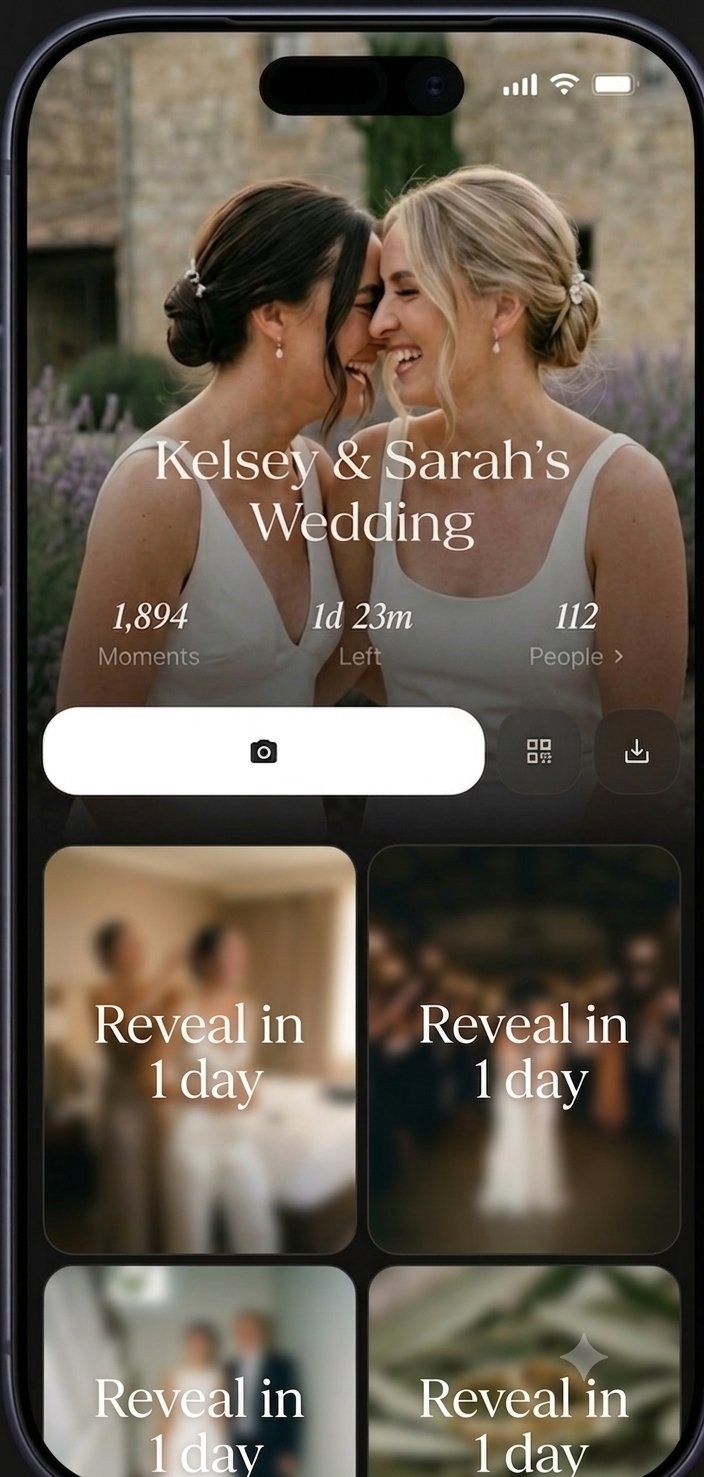
You create a film on Folio and set a reveal date: typically a week or two after the wedding. You share a link with every guest. Guests join and use Folio's camera to shoot throughout the day. Crucially, they cannot preview, filter, or delete any photos. On the reveal date, every single photo unlocks at once for the entire group.
What it solves
No development costs. No scanning. No lost cameras. High-quality smartphone photos instead of grainy film. And the reveal date creates an experience: a shared moment, usually over video call or at the post-wedding gathering: that physical cameras can't replicate.
What it keeps
The constraint. The surprise. The guest participation. The parallel album. The feeling of a disposable camera. All preserved digitally.
Physical vs Digital: Which is Right for You?
Physical disposable cameras are the right choice if the aesthetic (grain, film colour, imperfection) is genuinely important to you, and if you have the budget and patience for development. Some couples use them specifically for the look, treating the practical limitations as part of the appeal.
Digital disposable cameras via Folio are the right choice if you want the experience: the candid shots, the surprise, the guest participation: without the cost, logistics, or quality limitations. They're also right if you want to include guests who aren't in the same room (destination wedding guests who attended virtually, for instance).
Many couples do both: physical cameras on a few tables for the aesthetic, and Folio for the rest of the wedding to capture more of the day.
Whether physical or digital, the disposable camera wedding trend is popular because it solves a real problem: the default smartphone experience produces too many posed, filtered, self-conscious photos and too few genuine ones. The constraint of a camera you can't preview or delete changes behaviour, and the photos that result are consistently different, more honest, and more memorable.
Frequently asked questions
Yes: they produce genuinely different photos than smartphones because guests can't preview or delete shots. The constraint changes how people photograph. The main considerations are cost, development time, and photo quality in low light. A digital alternative like Folio gives you the same experience without these limitations.
A good rule of thumb is one camera per table. For a 100-guest wedding with 10 tables, that's 10 cameras. You can also place extras near the dance floor and bar, where candid moments are most likely. Expect to lose 20 to 30% of cameras by the end of the night.
The Fujifilm QuickSnap is the most popular and widely available. The Kodak FunSaver is a close second. For indoor/low-light use, choose the flash model. The Lomography Simple Use cameras are more expensive but produce more distinctive film aesthetics.
Folio is an iPhone app that replicates the disposable camera experience digitally. Guests shoot on their iPhones but can't preview or delete photos. You set a reveal date, and all photos unlock simultaneously for the whole group. It's the modern version of table disposable cameras.
In the UK, Boots Photo and Truprint offer postal development. In Europe, Rossmann and Dm pharmacy chains develop film in-store. For the best quality scans, specialist film labs like Filmdev (UK) or Carmencita (Spain) are worth the extra cost.
Ready to capture your next event?
Download Folio for free and create your first film in minutes. Everyone shoots. Nobody peeks. The reveal is the moment.